Home › Elevators/Lifts
Elevators/Lifts
Donam Engineering Co., Ltd. is a specialist OEM manufacturer of hydraulic freight/car elevators and lifts.
Specification
Elevator/Lift Specifications
Freight Elevator
| Rated load | Up to 1,000kg | 2,000kg | 3,000kg | 4,000kg | 5,000kg |
|---|---|---|---|---|---|
| Pulling load | 2,555kg | 4,981kg | 7,081kg | 10,771kg | 12,301kg |
| Max. rated speed | 9~ | 9~ | 9~ | 9~ | 9~ |
| Max. travel | 26m | 26m | 26m | 26m | 26m |
| Roping | 2:1 | 2:1 | 2:1 | 2:1 | 2:1 |
| Max. car weight | 1,400kg | 2,800kg | 3,900kg | 6,500kg | 7,000kg |
| Car inside dimensions (width) | 1,200~ | 1,200~ | 1,200~ | 1,200~ | 1,200~ |
| Car inside dimensions (depth) | 1,300~ | 1,300~ | 1,300~ | 1,300~ | 1,300~ |
| Car entrance (height) | 2,000~ | 2,000~ | 2,000~ | 2,000~ | 2,000~ |
| Landing entrance (width) | 1,200~ | 1,200~ | 1,200~ | 1,200~ | 1,200~ |
| Landing entrance (height) | 2,000~ | 2,000~ | 2,000~ | 2,000~ | 2,000~ |
| Door opening type | VO | VO | VO | VO | VO |
| Door operation | Automatic power-operated | Automatic power-operated | Automatic power-operated | Automatic power-operated | Automatic power-operated |
| Car door lock | Applied | Applied | Applied | Applied | Applied |
| Door closing safety device | Non-contact | Non-contact | Non-contact | Non-contact | Non-contact |
Car Elevator
| Rated load | 3,000kg | 4,000kg | 5,000kg |
|---|---|---|---|
| Pulling load | 7,081kg | 10,771kg | 12,301kg |
| Max. rated speed | 9~ | 9~ | 9~ |
| Max. travel | 26m | 26m | 26m |
| Roping | 2:1 | 2:1 | 2:1 |
| Max. car weight | 3,900kg | 6,500kg | 7,000kg |
| Car inside dimensions (width) | 2,500~ | 2,500~ | 2,500~ |
| Car inside dimensions (depth) | 5,200~ | 5,200~ | 5,200~ |
| Car entrance (height) | 1,800~ | 1,800~ | 1,800~ |
| Landing entrance (width) | 2,500~ | 2,500~ | 2,500~ |
| Landing entrance (height) | 1,800~ | 1,800~ | 1,800~ |
| Door opening type | VO | VO | VO |
| Door operation | Automatic power-operated | Automatic power-operated | Automatic power-operated |
| Car door lock | Applied | Applied | Applied |
| Door closing safety device | Non-contact | Non-contact | Non-contact |
Lifts
Non-standard — built to suit site conditions. Quote/Inquiry
Advantage
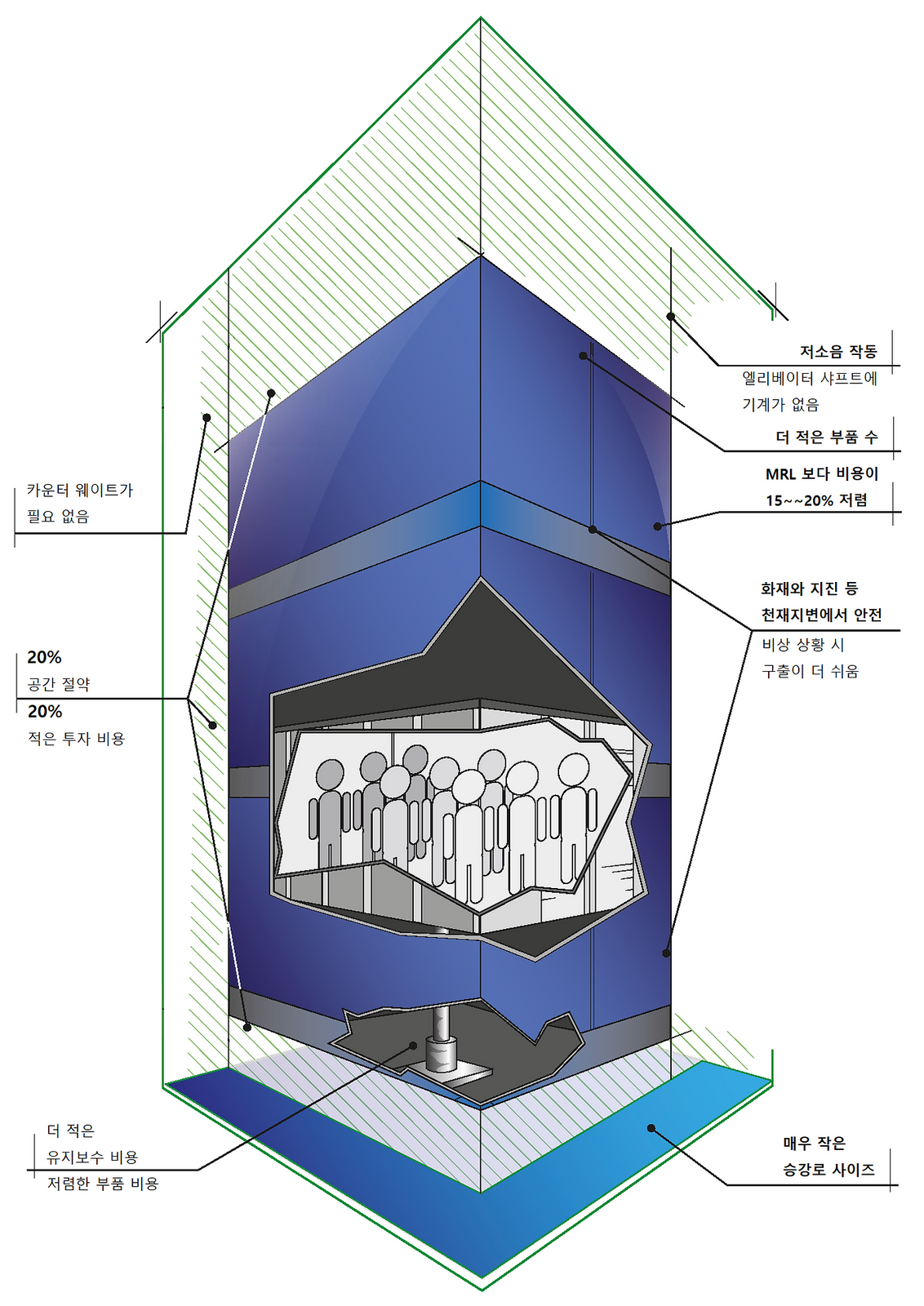
Advantages of Hydraulic Elevators
A. Advantages for the elevator installer (elevator company)
- Installation period: shorter than for roped elevators.
- As a complete hydraulic elevator system, it is more price-competitive than roped elevators.
- Parts are easy to source, and you are free from exclusive maintenance contracts that come with complex maintenance (roped type).
- Because hydraulic elevators are installed with fewer components than roped elevators, there are fewer parts to maintain and repair.
- The machine room is installed to suit site conditions, such as in the basement or at the top, so installation is easy and less hazardous.
- Hydraulic elevators operate smoothly with little mechanical wear, because the motor and pump run submerged in lubricating oil. They therefore require less maintenance than roped elevators.
- Roped elevators move by relying on the building walls and the like to carry the load, while hydraulic elevators operate by relying on the building foundation, so they are safer in earthquake-prone areas.
- They are especially efficient for heavy loads.
- Because the machine room is separate, there is less noise from the elevator.
- In an emergency (fire), they react less sensitively than roped elevators when water is sprayed from sprinklers or hoses.
- They are economical because downward travel is by gravity (the car's own weight).
- Even in an emergency, the situation can be resolved without entering the car top or the hoistway at the top floor.
B. Advantages for the building owner (client)
① Installation cost is about 15–20% lower than roped elevators, and maintenance cost is very low.
② Efficient use of building space and structure – lower construction costs
- Because hydraulic elevators do not use a counterweight, they save about 12% of the hoistway area.
- With hydraulic elevators, vertical loads do not need to be considered in the building structure, so the size of the hoistway columns can be significantly reduced.
- The machine room can be located freely to suit the building's structure and use.
- They can be installed in a building without a vertical shaft.
- Installing a roped elevator requires considerable cost and time for structural reinforcement at the top. Especially in older buildings, the safety of the upper structure must be reviewed, but hydraulic elevators do not require this.
- When a building is extended, hydraulic elevators can be installed more easily than roped elevators, without structural reinforcement.
③ Minimal energy and maintenance
- Energy consumption during upward travel is almost the same for hydraulic and roped elevators. However, since hydraulic elevators travel downward under their own weight, no energy is needed for downward travel, and only a small amount of heat is generated, saving energy.
④ In an emergency (elevator accident)
- Rescue work does not require a specialist.
- Even in an emergency, the situation can be resolved without entering the car top or the hoistway at the top floor.