UCMP Safety Check Valve
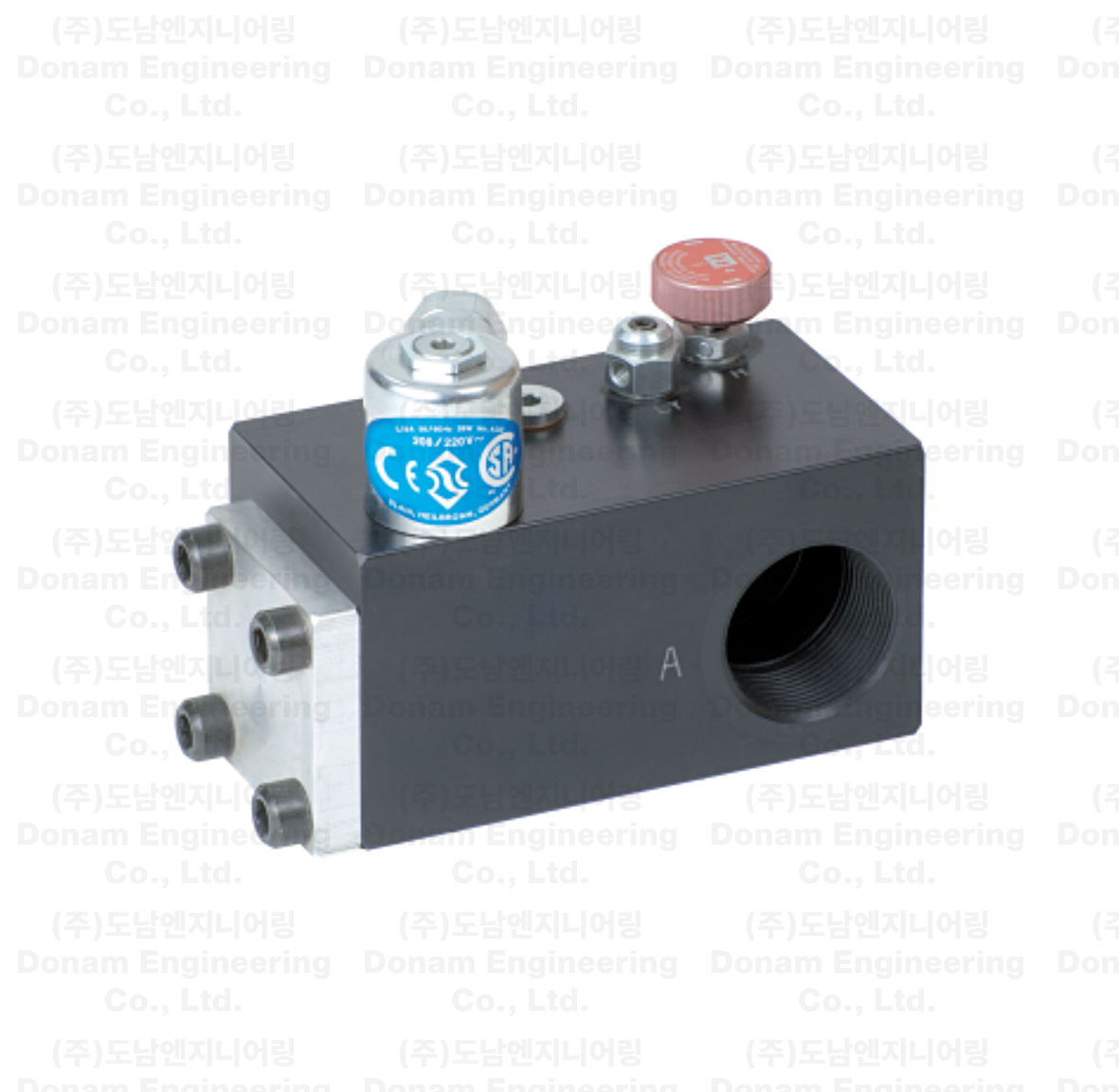
Unintended Car Movement Protection (UCMP)
- Size
- ½″ ~ 2½″
- Max. flow
- 80 ~ 1400 lpm
- Operating pressure
- 10 ~ 100 bar
1. Description
The UCMP safety check valve is a solenoid-operated check valve designed for hydraulic elevators and includes a self-closing manual lowering valve. Its purpose is to allow oil to flow freely from the pump unit A to the cylinder B for upward travel, and to prevent reverse flow from B to A until an electrical signal is given to the solenoid.
Installed directly on the control valve, the UCMP safety check valve can be used as a safety backup valve in the down system of the control valve, to prevent unintended downward travel of the elevator in the event of an electrical or mechanical malfunction in the control valve.
As another application, the UCMP safety check valve can be mounted directly above the EV connection to reduce vibration in the hydraulic elevator system caused by the compressibility of the oil between the cylinder and the control valve.
The slack rope valve LK (e.g. 2:1 indirect transmission) can also be used for roped elevators. It prevents the slack rope condition caused by the descent of the ram when the car is suspended in the safety gear and resting on the buffer.
2. Dimensions
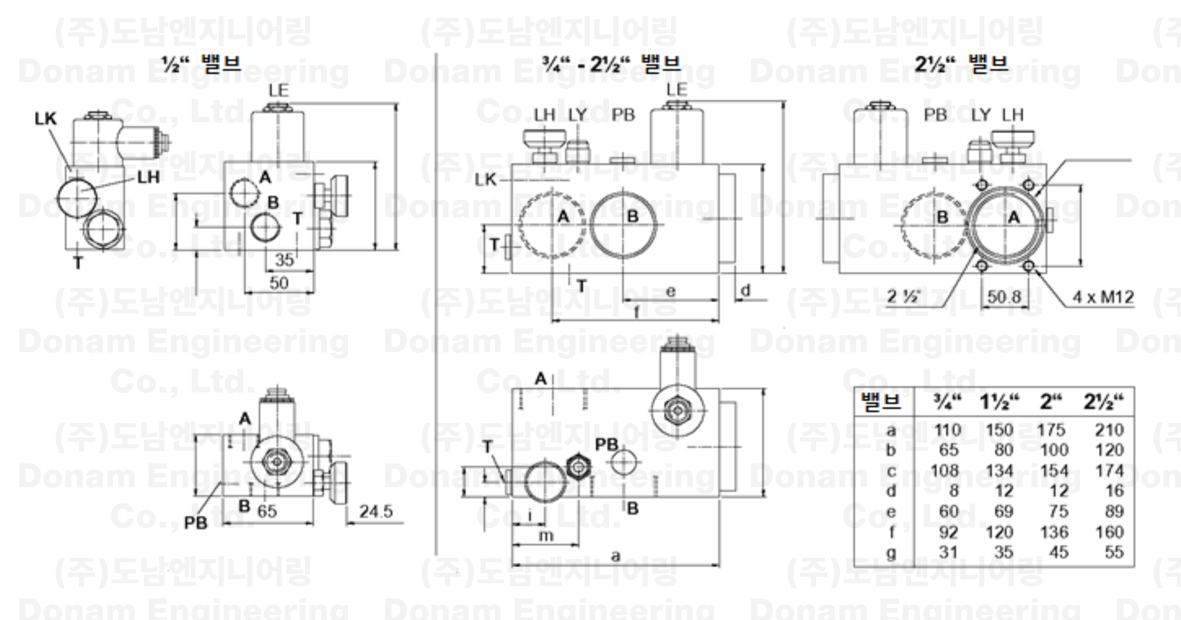
3. Specifications
| Size | ½″ | ¾″ | 1½″ | 2″ | 2½″ | |
|---|---|---|---|---|---|---|
| Max. flow range | lpm | 80 | 125 | 400 | 800 | 1400 |
| Min./max. operating pressure | bar | 10 ~ 100 | 10 ~ 100 | 10 ~ 100 | 10 ~ 80 | 10 ~ 70 |
| Burst pressure | bar | 500 | 500 | 500 | 450 | 365 |
| Tank connection | T | ¼″ | ¼″ | ½″ | ½″ | ½″ |
| Weight | kg | 0.8 | 1.4 | 2.5 | 4.2 | 7.0 |
| Cylinder pressure port (PB) | G ¼″ | |||||
4. Operation
- Rest position
- When the UCMP safety check valve is on standby, the SC (solenoid) LE is not energized and the main flow guide LV is closed, preventing oil from flowing from the cylinder to the tank.
- Upward travel
- During upward travel with the pump running, oil passes through port A, through the flow guide LV, and exits through port B to the main cylinder. Solenoid LE is not energized.
- Downward travel
- For downward travel of the car, the UCMP safety check valve must open about 0.5 seconds earlier than the main control valve. This allows oil to escape from the pilot chamber (see drawing) so that the main piston LV can open. Otherwise, the pressure in the connecting line between the UCMP safety check valve and the control valve drops considerably, and the connecting line must be repressurized to put the elevator back into operation. This can be done by briefly starting the elevator in the upward direction or by pumping oil with the hand pump. Repressurization may also be required if there is internal leakage in the control valve.
When LV opens, oil flows from the cylinder to the tank (from B to A) through the UCMP safety check valve and the control valve.
To stop the elevator, solenoid LE on the UCMP safety check valve must be de-energized together with the down solenoid (D) of the control valve. In this way, the piston LV in the UCMP safety check valve and the down piston X in the control valve close completely.
- Pressure drop
- The pressure loss of the UCMP safety check valve depends on the valve size and flow rate. The size and type of the connectors used also affect the pressure loss. The pressure loss of the UCMP safety check valve must be taken into account when calculating the empty-car pressure for the control valve.
- Emergency lowering
- The emergency manual lowering LH on the UCMP safety check valve must be operated to lower the car in an emergency. The lowering speed of the car is determined by the setting of LY. When LH is open, oil from the cylinder returns to the tank through the return tank line attached to tank port T. The return tank line must not be smaller than tank port T; otherwise, emergency manual lowering may not work properly. The slack rope valve LK prevents the descent of the ram to prevent a slack (tangled) rope condition when manual lowering LH is operated in a 2:1 roped elevator.
- Bleeding air
- After connecting the UCMP safety check valve or right after repair, air must be bled to check that it works properly. Operate the emergency lowering valve or slightly loosen the solenoid tube until oil appears, then tighten it again.
5. Adjustment
- Manual lowering speed LY
- (¾˝, 1½˝, 2˝ and 2½˝ valves): ‘in’ (clockwise) makes the lowering speed slower and ‘out’ (counterclockwise) makes the lowering speed faster.
- Slack rope valve LK
- Using a 3 mm hex wrench, turning LK clockwise increases the pressure and counterclockwise (out) decreases it. After turning LK clockwise all the way and then turning it counterclockwise by half a turn, the empty car should descend when the LE solenoid is energized.
If the car does not descend, LK must be turned back counterclockwise until the car starts to descend; then check for cold oil and, if present, turn it back counterclockwise another half turn so that the car descends as required.
6. Function check
To check the function of the UCMP safety check valve, solenoid LE may be de-energized during downward travel.
Alternatively, it can be tested by loosening the retaining nut MM and lifting the solenoid coil M manually.
A function test may cause a pressure drop in the connecting line between the UCMP safety check valve and the control valve. To make the elevator operable, the connecting line needs to be repressurized. This can be done by moving the cabin briefly in the upward direction using the hand pump. Pressurizing the line may also be necessary, for example, if the pressure loss between the UCMP safety check valve and the control valve is high due to internal leakage.
7. Coil power by elevator state
| Elevator state | Power supply to the UCMP safety check valve coil |
|---|---|
| Upward travel and re-levelling | Power OFF |
| Downward travel and re-levelling | Power ON |
| Stopped with doors closed | Power can be switched off to save standby power. |
| Moving up with doors open | Motor OFF once the movement sensor is tripped |
| Moving down with doors open | Power OFF once the movement sensor is tripped |
| Emergency lowering | Power ON |
| Emergency manual lowering | Manual operation |
| Hand pump operation | Power OFF |
8. Construction and parts
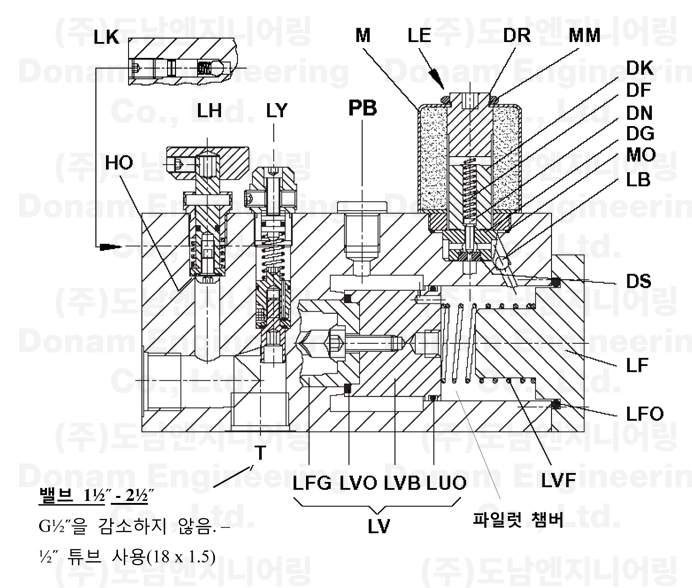
| No. | Parts list |
|---|---|
| LF | Flange |
| LFO | O-ring - flange |
| LB | Ball |
| LVF | Spring - flow guide |
| LFG | Flow guide |
| LVO | Seal - flow guide |
| LVB | Body - flow guide |
| LUO | O-ring - flow guide |
| LH | Manual lowering - self-closing |
| LY | Manual lowering speed adjuster |
| HO | Seal - manual lowering (5.28 x 1.78) |
| MM | Nut - solenoid |
| M | Coil - solenoid (voltage marked) |
| DR | Tube - solenoid |
| MO | O-ring - solenoid |
| DF | Spring - solenoid |
| DN | Needle - solenoid |
| DK | Core - solenoid |
| DG | Seat housing (with screen) |
| DS | Seat - solenoid |
9. Hydraulic circuit
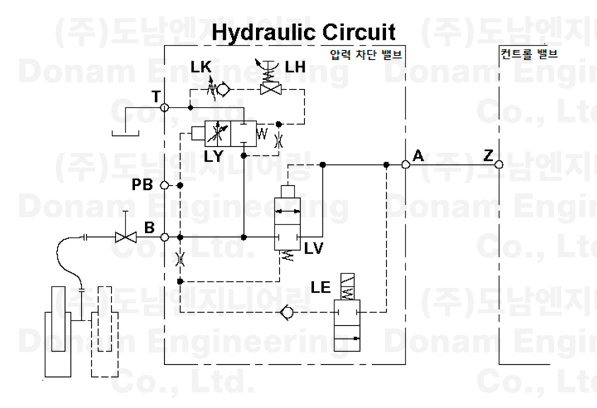
Control elements
- LV Check valve
- LH Manual lowering
- LK Slack rope valve (option)
- LE Solenoid
- PB Pressure gauge
- LY Manual lowering speed adjustment (not fitted on ½″ valve)
Connections
- A Control valve connection
- B Cylinder side connection
- T Tank return line