Hydraulic Power Unit Specifications and Tank Selection
Calculating the required hydraulic oil volume and selecting the tank
➞ The oil volume is calculated from the diameter and length of the cylinder.
| Item | Formula | Drawing mark | Remarks |
|---|---|---|---|
| Working oil volume (ℓ) | = {A(cross-sectional area - cm²) x L(cylinder length - cm)} ÷ 1000 → A = cylinder radius(cm) x radius(cm) x 3.14 → Dividing by 1000 converts the result to litres (ℓ). | ⓐ | |
| Basic required volume (ℓ) | = the volume needed to keep the motor and pump submerged even when the elevator is at the top floor | ⓑ | |
| Required oil volume (ℓ) | = working oil volume + basic required volume | ⓐ+ⓑ | |
| Tank size (ℓ) | We provide the optimal tank by calculating the minimum required volume and the basic required volume | ||
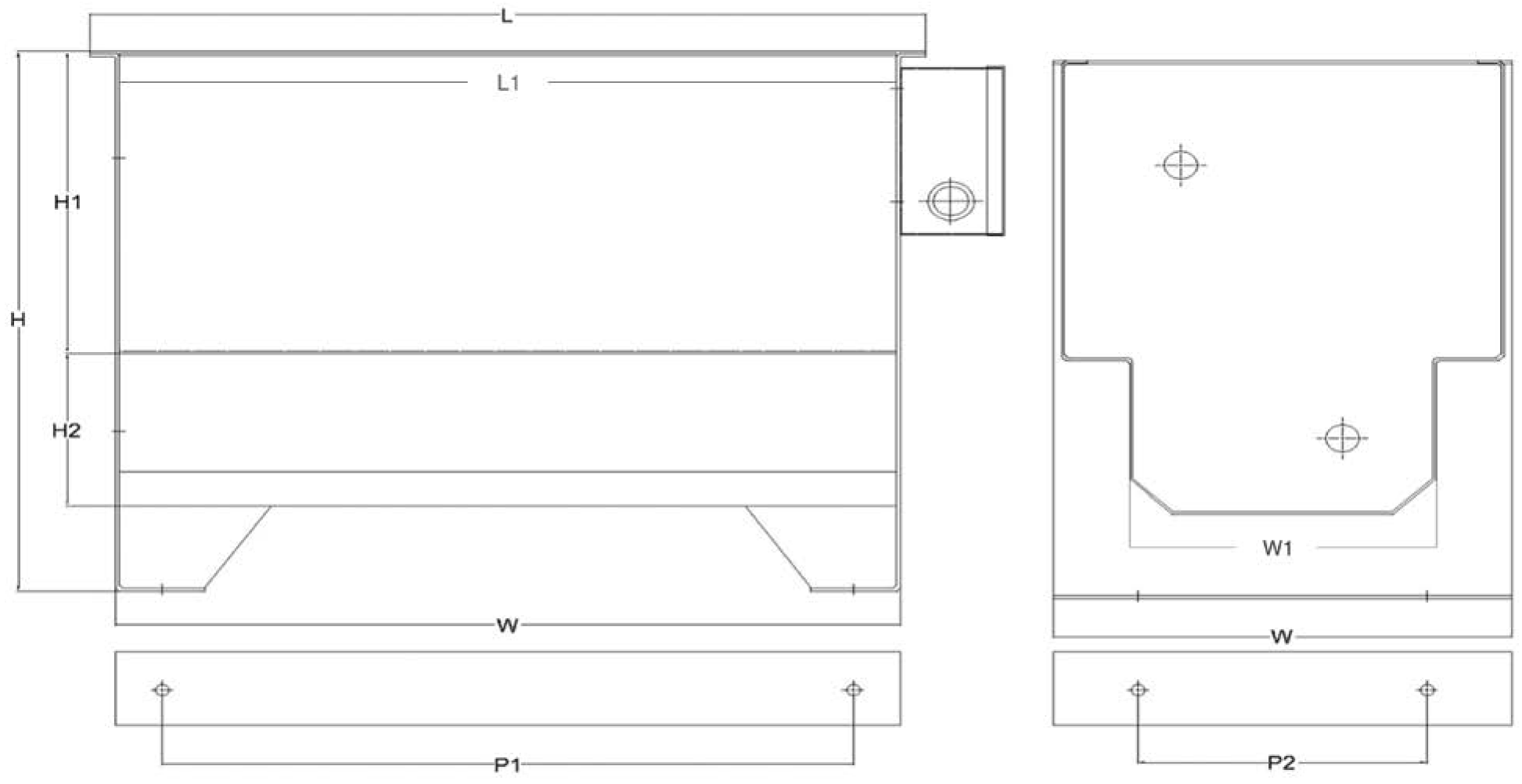
Hydraulic tank dimension drawing
| Tank type | Tank upper part (mm) | Tank lower part (mm) | Required oil volume (ℓ) ⓐ+ⓑ | Hole dimensions (Ø17) | Weight (kg) | ||||||||
|---|---|---|---|---|---|---|---|---|---|---|---|---|---|
| L | W | H = (H1+H2+120) | Working oil volume (ℓ) ⓐ | H2 | W1 | W | Oil volume ⓑ | ||||||
| Overall height (H) | Upper height (H1) | P1 | P2 | ||||||||||
| A | 923 | 540 | 776 | 435 | 200 | 220 | 260 | 540 | 43 | 243 | 813 | 340 | 93 |
| B | 1,228 | 825 | 485 | 300 | 343 | 1,118 | 116 | ||||||
| C | 570 | 925 | 585 | 400 | 290 | 570 | 49 | 449 | 370 | 130 | |||
| D | 1,055 | 715 | 500 | 549 | 147 | ||||||||
| E | 1,533 | 995 | 655 | 600 | 360 | 640 | 65 | 649 | 1,423 | 167 | |||
| F | 640 | 1,195 | 855 | 800 | 865 | 440 | 199 | ||||||
| Type | L1 | W | H | Oil volume |
|---|---|---|---|---|
| SA 60 | 650 | 270 | 423 | 60 |
| SA 70 | 573 | 70 | ||
| SA 80 | 623 | 80 | ||
| SA 90 | 703 | 90 | ||
| SA 120 | 809 | 450 | 869 | 120 |
➞ Working oil volume (l): ⓐ = (L1 x W1 x H1) / 1000
➞ Basic oil volume (l): ⓑ = (L1 x W1 x H2) / 1000
➞ Required oil volume (l) = ⓐ (working oil volume) + ⓑ (basic oil volume)