Control Valve Adjustment and Method
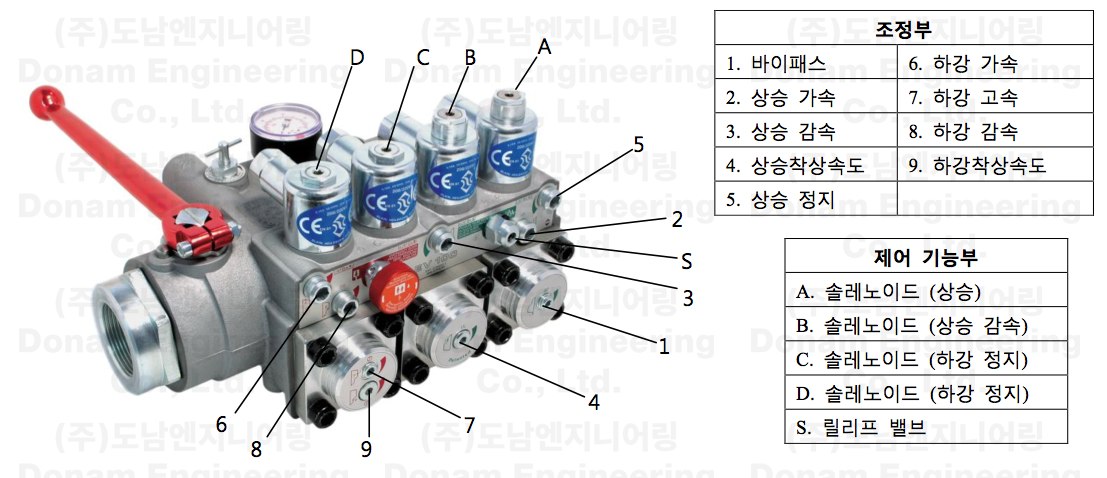
Start · Pressure (#1, S)
#1
Bypass
Adjuster #1 · GreenFunction
- Once the elevator specifications are decided and the pump delivery is calculated, a valve matching the specifications is shipped.
- → When coil A is de-energized, the car does not move even if the motor is running.
How to adjust
- After the pump starts and coils A and B are energized, the car does not start immediately but stays still for 1 ~ 2 seconds.
- Adjuster #1 adjusts this standstill time.
- Clockwise shortens the standstill time,
- counterclockwise lengthens it.
S
Pressure control valve adjustment S
Function
- Close the shut-off valve and adjust until the specified value is reached. Then lock it with the headless bolt.
Upward travel (#2 ~ #5)
#2
Upward acceleration
Adjuster #2 · GreenFunction
- Once the pump runs and the coils are energized, the car can be accelerated or decelerated by adjusting #2.
- → If the acceleration with adjuster #2 is satisfactory, make no further adjustment.
- Adjuster #2 affects adjusters #3 and #4.
How to adjust
- Turn clockwise for gentle acceleration
- Turn counterclockwise for rapid acceleration
#3
Upward deceleration
Adjuster #3 · GreenFunction
- Adjust #3 until satisfactory deceleration is obtained. Then fix the safety switch. This activates the coil to obtain a creep distance of 3 ~ 5 cm.
- The travel speed in m/sec equals the distance between the safety switch and the landing switch. That is, at V = 0.5 m/sec, the distance is 0.5 m
How to adjust
- When coil B is de-energized while coil A remains energized, the car decelerates according to adjuster #3.
- Turn clockwise for gentle deceleration
- Turn counterclockwise for rapid deceleration
#4
Upward landing
Adjuster #4 · GreenFunction
- Adjusts the creep speed.
- V = 5 ~ 7 cm/sec
How to adjust
- When coil A is energized and coil B is de-energized, the landing speed changes according to adjuster #4. To adjust the landing speed,
- turn clockwise for slower landing
- turn counterclockwise for faster landing
#5
Upward stop
Adjuster #5 · GreenFunction
- At the landing floor, when coil B is de-energized, coil A is de-energized.
- → If the pump is run 0.5 seconds longer via a time relay, the car stops smoothly according to adjuster #5.
- → Speed is not raised further with the adjuster; it is determined by the pump delivery.
How to adjust
- Use adjuster #5 to land the car smoothly.
- Clockwise: soft stop
- Counterclockwise: abrupt stop
Downward travel (#6 ~ #9)
#6
Downward acceleration
Adjuster #6 · RedFunction
- When coils C and D are energized, downward acceleration is set by adjusting adjuster #6.
How to adjust
- Clockwise: gentle downward speed
- Counterclockwise: fast downward speed
- → Adjuster #8 affects adjuster #6. Readjust adjuster #6 if necessary.
#7
Downward travel
Adjuster #7 · RedFunction
- When coils C and D are energized, the maximum downward speed of the car is determined by adjuster #7.
How to adjust
- Clockwise: gentle downward speed
- Counterclockwise: fast downward speed
#8
Downward deceleration
Adjuster #8 · RedFunction
- Soft downward deceleration test (soft stop test)
- When coils C and D are de-energized at maximum downward speed, the car must come to a gradual, smooth stop within 20 cm.
How to adjust
- When coil C is de-energized while coil D remains energized, the car decelerates according to adjuster #8.
- Clockwise: gentle deceleration
- Counterclockwise: rapid deceleration
- → If the deceleration is satisfactory, make no further adjustment to adjuster #8. Adjuster #6 may then need to be readjusted.
#9
Downward landing
Adjuster #9 · RedFunction
- When coil C is de-energized and coil D is energized, the downward landing is set by adjuster #9.
- → When coil C is de-energized the car stops according to adjuster #8, so no further adjustment is needed.
How to adjust
- Clockwise: gentle downward landing
- Counterclockwise: fast downward landing