Why a Hydraulic Elevator Sinks and How to Check
Causes and fixes compiled from the technical data of a control valve and cylinder manufacturer.
When a parked hydraulic elevator car has drifted down, the first suspicion is an oil leak. But the car also sinks when the oil cools and contracts. The criteria below tell you whether it is a leak.
The car sinks even when the oil only cools
While the elevator stands idle, the oil temperature falls and the oil in the cylinder and piping contracts, so the car goes down. It sinks very slowly, but over a day without re-levelling it can drop by almost 0.5 m, depending on how far the oil temperature falls and on the temperature and volume of the cylinder system. If the re-levelling device works properly, it brings the car back to the landing level.
Control valves are built to be leak-free, but fine contamination in the oil means they cannot always seal perfectly. The code requires a safe re-levelling system, so slight valve leakage is not a problem.
Two ways to check for a leak
1. EN 81-2 criterion: 10 mm in 10 minutes
Without leakage, a loaded elevator must not sink more than 10 mm in 10 minutes. This is the basic test for deciding whether the valve needs service.
2. Faster method: the 20-second gauge check
Close the ball valve on the cylinder line and watch the gauge showing the pressure in the valve's cylinder chamber. If the pressure falls to zero within 20 seconds, the valve may need repair, depending on the ram (cylinder rod) diameter and the sensitivity.
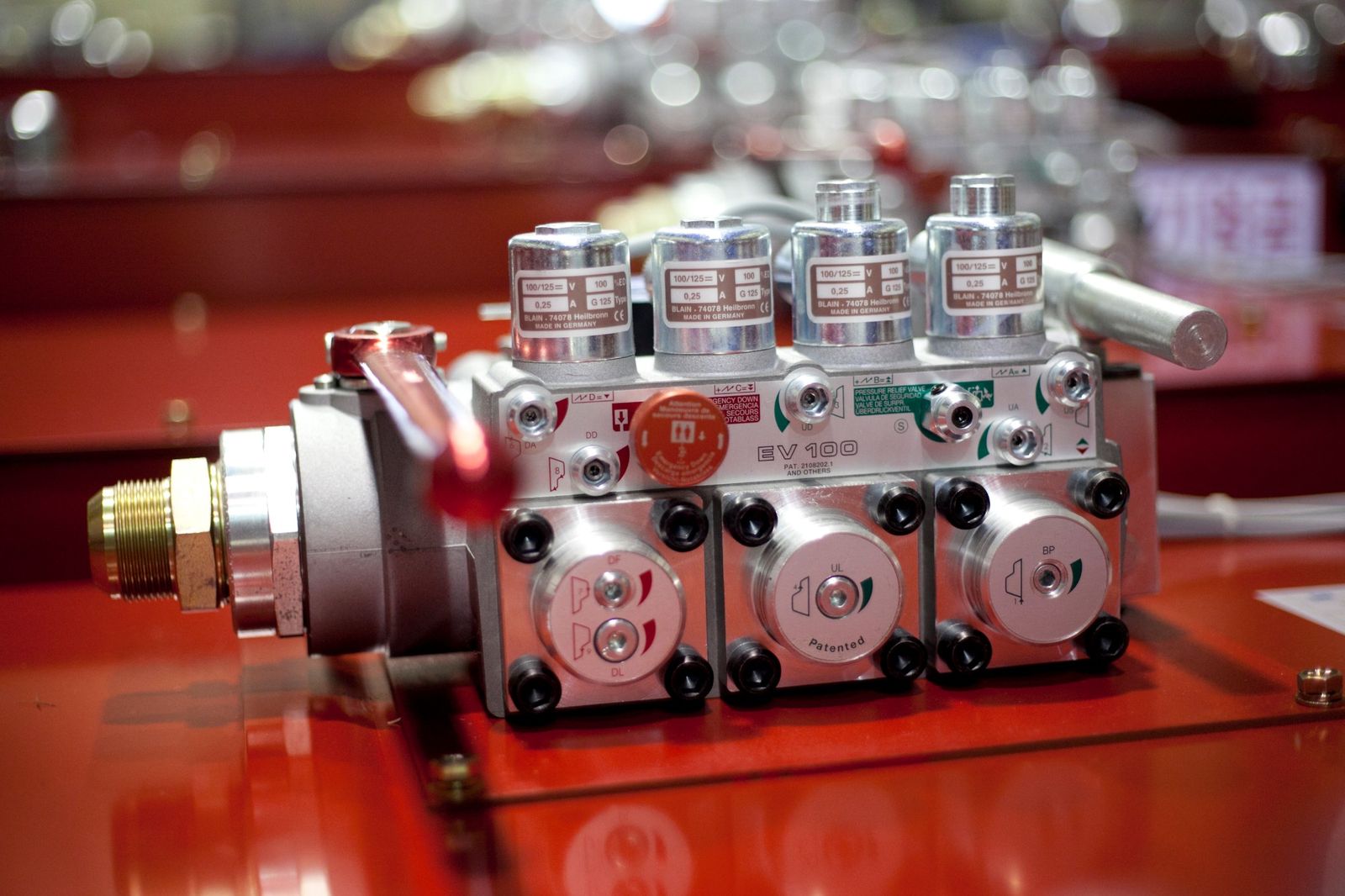
Causes and fixes by symptom
From Donam Engineering's technical note Other symptoms and solutions.
The car comes down after it has stopped
| Cause | Fix |
|---|---|
| Oil leaking from the cylinder or piping | Find the leak and fix it. |
| A lot of air in the cylinder | Bleed the air thoroughly. |
| Contamination on solenoid coil D | Disassemble and clean (a filter is fitted). |
| Leak at manual lowering valve H | Disassemble, inspect and replace the O-ring. |
| Leak at the check valve | Disassemble, inspect and replace the O-ring. |
| Adjuster #8 closed too far | Turn adjuster #8 counter-clockwise little by little. |
| O-rings of adjusters #7 and #9 displaced, broken or contaminated | Disassemble, inspect and replace the O-rings. |
The car drops a lot when loaded
| Cause | Fix |
|---|---|
| Wrong cylinder selection, large pressure difference | Recalculate the capacity. |
| Stretched wire ropes | Check and fix. |
| A lot of air in the cylinder | Bleed the air. |
The car stops off the landing level
| Cause | Fix |
|---|---|
| Levelling limit switch in the wrong position | Correct the limit switch position. |
| Deceleration too fast | Turn adjuster #4 clockwise. |
| Adjuster #5 closed too far | Turn adjuster #5 counter-clockwise. |
Adjuster numbers refer to Donam control valves. Positions and functions are in Control valve adjustment.
If the car drops when a forklift drives in
When a forklift carries a heavy load into the car, the car can drop momentarily so that the forklift cannot climb over the sill. A level compensation device detects this instantly, tops up oil in the cylinder and restores the car floor to the landing level.
- Fast level compensation
- Prevents main motor burnout and extends its life
- Extends the life of the control contactors and saves electricity
- Prevents the oil temperature from rising
Order for replacing leaking valve parts
If the control valve leaks, replace and check one part at a time in this order. Move to the next part only if it still leaks after replacing the previous one.
- Needle (DN) and seat (DS) of solenoid valve D
- O-ring (XO) of lowering valve X
- O-rings (VO, WO) of check valve V
- Inner O-ring (FO) of flange 4F
- O-ring (HO) of manual lowering H
O-ring sizes by valve size are in Control valve system leakage (re-levelling). Do not remove the filter (FF) inside the valve.
Will the car fall if a pipe bursts?
A rupture valve (fall-prevention valve) is connected directly to the cylinder's oil inlet. If the main pipe bursts and the car speeds up beyond the rated speed, the valve closes and the car stops gently with a deceleration of less than 1 g. The closed valve opens automatically when the car is run upward again.
Frequently asked questions
The car is a little lower every morning. Is it broken?
Oil cooling and contracting overnight can lower the car. If the re-levelling device works, it brings the car back to the landing. If you suspect a leak, check whether the loaded car sinks more than 10 mm in 10 minutes.
Is a small valve leak dangerous?
Slight control-valve leakage is covered by the re-levelling device, as the code requires, so it is not a problem. Oil leaking from the cylinder or piping must be located and fixed.
Does the oil temperature matter?
Yes. Oil viscosity and volume change with temperature. See Hydraulic elevator oil care.
Sinking and leak inquiry
Tell us the site, the elevator's use and load, the symptom and years in service, and we will advise on the cause and fix.
Based on Donam Engineering's technical notes (power unit overheating and system leakage, other symptoms and solutions, level compensation, control valve system leakage, rupture valve, pressure relief valve). Written October 2026.