Hydraulic Elevator Oil: Change Interval and Care
Compiled from the technical data of a manufacturer of hydraulic power units and oil coolers.
A hydraulic elevator raises the car by pumping oil from the tank into the cylinder, and lowers it by letting the car's weight push the oil back to the tank. The oil's temperature, viscosity and volume therefore decide ride quality and equipment life. Two basics matter most: change the oil every 1–2 years, and keep the oil below 55 °C.
What happens when the oil runs hot
- Pump efficiency drops sharply and pump life is shortened.
- Oil life is also shortened quickly. As viscosity drops, the oil has to be changed sooner.
- Lower viscosity makes control-valve regulation less accurate.
- It also harms the hydraulic motor.
Causes of overheating
- The up-levelling speed is too slow, or the slow-down switch is set too low, so levelling takes too long.
- The machine room is poorly ventilated.
- The elevator runs more often than the heat can escape.
Until the cause is fixed, slowing the down speed temporarily reduces frequent runs and helps avoid overheating.
Fixes: ventilation → radiator → oil cooler
1. Mild overheating: ventilation
If, for example, the oil rises from 20 °C to 55 °C over 2–3 hours, better air circulation around the power unit may be enough. Install a 0.05–0.10 kW exhaust fan or blower to move machine-room air outside.
2. When ventilation is not enough: air-cooled radiator
Circulate the hot oil with a 10–50 ℓ/min pump through an air-cooled radiator with a 0.1–0.2 kW fan. Place the cooler outside the machine room (for example in the hoistway) and also extract the hot machine-room air.
3. Oil cooler
The cooling system should start working when the oil reaches 30–35 °C. Donam Engineering's oil cooler is air-cooled, and a digital temperature controller switches it on and off by the set temperature. It comes in 14 kW (12,000 kcal) and 20 kW (17,000 kcal). We recommend an oil cooler to protect the equipment, extend oil life and keep the ride comfortable.
When the oil is too cold
The viscosity of hydraulic oil changes with the seasonal air temperature, the load and the cylinder size. When the oil cools below a suitable level overnight or during long idle periods, an oil heater warms it so that the control system works smoothly.
When the oil contracts or a heavy load comes on, the car can drop momentarily and the car floor no longer lines up with the landing. A level compensation device then tops up oil in the cylinder to restore the level.
The right viscosity
- Control valve adjustment: works best at an oil viscosity of 33–152 cSt (mm²/s).
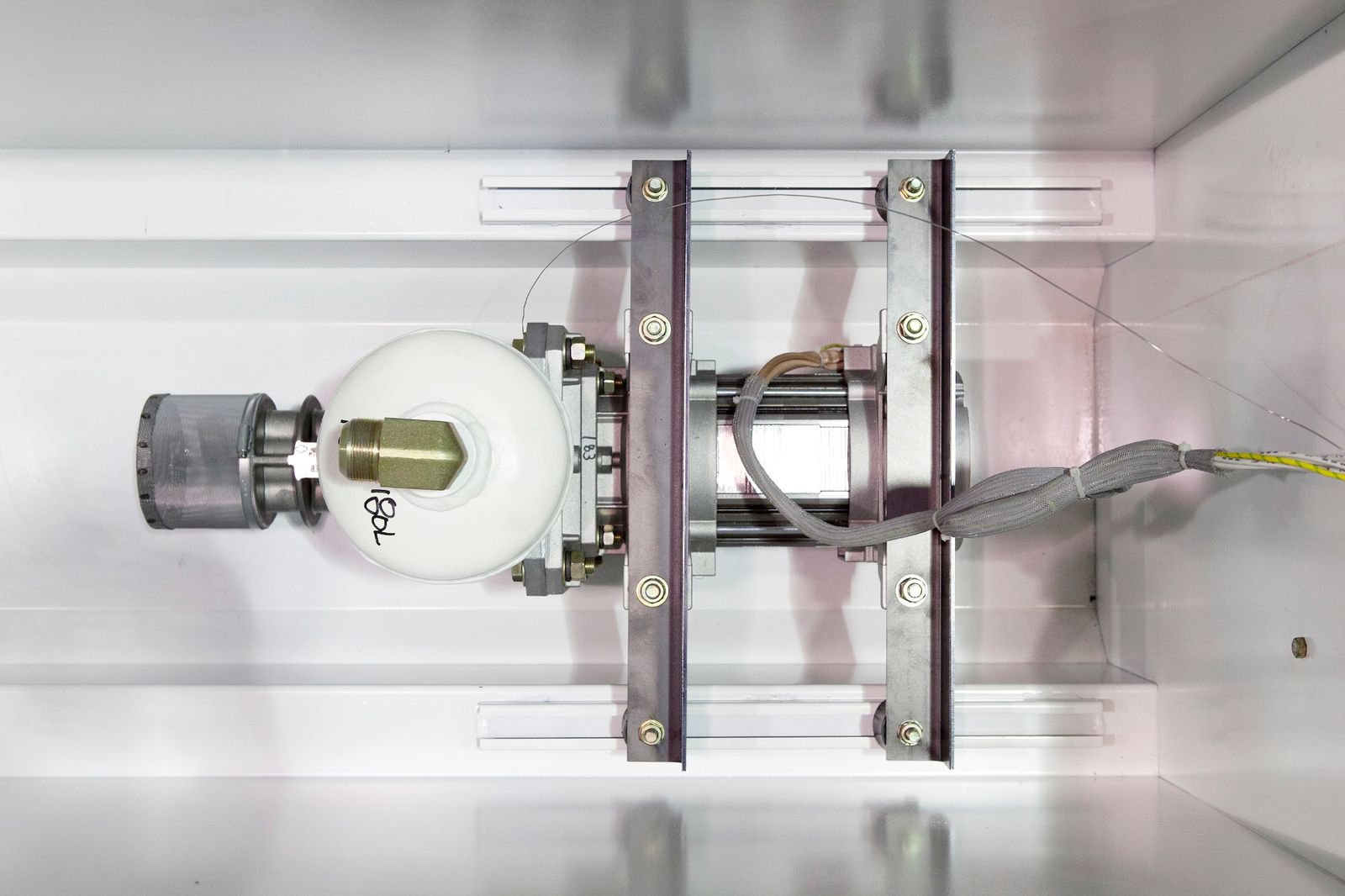
- Rupture valve (fall-prevention valve) operating range: viscosity 50–75 cSt, temperature 20–60 °C.
Sources: Donam hydraulic technical data book; Rupture valve
Calculating the oil volume
The oil volume for the tank is calculated from the cylinder diameter and length.
- Working oil (ℓ) = cylinder cross-section (cm²) × cylinder length (cm) ÷ 1000 (cross-section = radius × radius × 3.14)
- Base volume (ℓ) = the oil needed to keep the motor and pump submerged even with the car at the top floor
- Oil required (ℓ) = working oil + base volume
Tank dimensions and oil volumes by type are in Power unit specifications and tank selection. The tank's oil level can be checked on the oil level gauge.
How often should the oil be changed?
Donam Engineering recommends changing the hydraulic oil every 1–2 years. The hotter the oil runs, the faster its viscosity drops and the sooner it needs changing, so sites with frequent runs or hot oil should change it closer to the 1-year mark. To make the oil last, first keep it below 55 °C.
Between changes, check the following at each regular inspection. For the oil change itself, contact your maintenance company or Donam Engineering.
- The oil never exceeds 55 °C
- There is enough oil in the tank (oil level gauge)
- No contamination is visible in the tank
- No oil leaks from the cylinder, piping or valve
The filter (FF) inside the control valve removes contamination from the oil and must not be removed.
Frequently asked questions
How often should hydraulic elevator oil be changed?
Donam Engineering recommends every 1–2 years. Sites with frequent runs or high oil temperatures need it sooner.
What is the right oil temperature?
Keep it below 55 °C. The cooling system should start working when the oil reaches 30–35 °C.
Is an oil cooler always necessary?
Mild overheating can be solved with machine-room ventilation alone. If ventilation and a radiator are not enough, or the elevator runs frequently, we recommend an oil cooler.
The elevator sinks a little — is it the oil?
It may be a leak, but the car also sinks as the oil cools and contracts. See Why a hydraulic elevator sinks.
Overheating and leak consultation
Tell us the site, the elevator's use and load, and the symptom, and we will advise on the cause and fix.
Based on Donam Engineering's hydraulic technical data book, hydraulic catalogue, technical notes (power unit overheating, oil cooler, oil cooler temperature setting, oil heater, level compensation, rupture valve, power unit specifications and tank selection) and Donam's recommended oil change interval (1–2 years). Written October 2026.